
Prime Minister Narendra Modi and Russian President Vladimir Putin held extensive discussions to strengthen bilateral trade, defence, and energy cooperation, while also addressing the ongoing Ukraine conflict and exploring avenues for peace and resolution, with Modi reiterating India's call for dialogue and diplomacy.

Senior Congress leader Shashi Tharoor has articulated India's position on BRICS, advocating for it to be a "non-West, but not anti-West" platform, a stance he believes is crucial for India's national interest. He highlighted the prestige of hosting the BRICS summit, India's responsibility to represent the Global South, and the significance of bilateral meetings, particularly with China and Russia. Tharoor also addressed the strained India-China relations, citing border issues and trade leverage, and discussed the challenges within BRICS, including difficulties in achieving consensus on global issues and trade imbalances, while also considering the need for diversified international relations amidst unpredictable US sanctions.

New Delhi must look for formal, institutional statements issued directly from Washington rather than rely on casual pronouncements meant for local audiences, notes Ambassador Rajasekhar.

Notwithstanding the economic complementarities and the host of agreements for deepening economic relation on a host of areas, both sides share common viewpoints on the foreign policy domain and seek common grounds to serve as a counterweight to China, notes Dr Rajaram Panda.

External Affairs Minister S Jaishankar has engaged in multiple conversations with his Iranian counterpart to secure safe passage for Indian merchant vessels through the Strait of Hormuz amidst escalating tensions in West Asia.

The economic fallout of the West Asia crisis, the prevailing security situation in the Indo-Pacific and ways to boost cooperation in critical minerals and technology are expected to top the agenda at a crucial meeting of the Quad foreign ministers on Tuesday.

India's handling of the Iran crisis reflects a growing strain between strategic autonomy and geopolitical alignment, observes Ambassador M K Bhadrakumar.

Gor, 38, was among 107 nominees confirmed by the Senate in a single en bloc vote on Tuesday, with 51 senators voting in favour and 47 against.

China has reacted positively to Russian President Vladimir Putin's visit to India, emphasizing the importance of trilateral ties between China, Russia, and India for regional and global peace and stability.

India has called for a ceasefire, release of all hostages, and peaceful resolution of the Israel-Hamas conflict through dialogue and diplomacy. The Centre informed Parliament that India welcomed the agreement on the first phase of the Gaza Peace Plan. The article also covers India's energy sourcing strategy and the release of Indian fishermen by Pakistan.

Social media feeds and immigration forums lit up with questions from workers and families who feared they might be stranded abroad, unable to return to their jobs or reunite with loved ones.
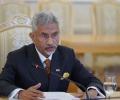
The relations between New Delhi and Washington are on a downturn after Trump doubled tariffs on Indian goods to a whopping 50 per cent, including 25 per cent additional duties for India's purchase of Russian crude oil.
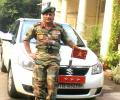
Lieutenant General Shakti Gurung deserves to be complimented in telling his life story and that of his people, as subaltern communities within this vast and diverse nation of ours clamour for recognition and a plea for their voices to be heard and their aspirations to be met, notes Lieutenant General Gautam Moorthy.

'While my generation carries with it the memory of the Chinese perfidy of 1962, this generation will carry the memory of Chinese perfidy in Galwan.'
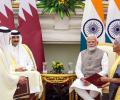
India and Qatar on Tuesday agreed to elevate their relationship to a strategic partnership and double bilateral trade to USD 28 billion over the next five years. Prime Minister Narendra Modi and Qatari Amir Sheikh Tamim Bin Hamad Al-Thani signed agreements and MoUs to strengthen economic cooperation, including a revised double taxation avoidance agreement. The strategic partnership will cover the "entire spectrum" of the bilateral relationship, including trade, energy security, and regional and international cooperation. Both leaders also discussed ways to further strengthen and broaden the energy partnership, including "exploring mutual investments." The Amir's visit provided an "excellent opportunity" for the top leadership of the two countries to discuss and "cement a strategic partnership for enhanced future cooperation."

He is only the agent that can bring them that change for they are quite aware that he has articulated no vision on how to set Pakistan back on the rails, notes Lieutenant General Gautam Moorthy (retd).

Prime Minister Narendra Modi and French President Emmanuel Macron have called for enhancing trade and investment ties between their countries and committed to further deepening their engagement in the Indo-Pacific. They discussed a full spectrum of bilateral relations, including key global and regional issues, and stressed the urgent need for reform in the United Nations Security Council. The leaders also underscored their commitment to ensuring the global AI sector can drive positive social, economic, and environmental outcomes.
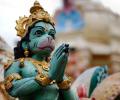
As the US gets tougher with visas, the prayers of US-bound devotees in India are getting more fervent, and their purse strings looser. Called Visa Hanuman temples (there are half a dozen all over India), some of them ask for a 'fee'.

'Given China's past behaviour and their territorial claims, should we be sceptical regarding China's willingness to adhere to these agreements fully? The answer is yes.' 'As Ronald Reagan famously said in the context of the SALT talks, 'Trust, but verify!' India should also do the same.' 'This has already begun with foot patrolling, drones, satellite imagery and so on. India's military deployment did mirror China's and will continue to do so in the future.'

India would not be seen to be anything but rude with the Pakistanis. In the big picture, who is the bigger adversary right now? Who is the bigger pain in the neck? And who is it that is keeping more than 3,000 km of our borders active, throwing our military posture and deployments into imbalance? asks Shekhar Gupta.
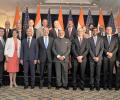
Prime Minister Narendra D Modi's itinerary for his June 21-24 US visit could include an address to a fledgling business advocacy group, the US-India Strategic Partnership Forum.

At the invitation of Prime Minister Narendra Modi, President Xi Jinping and PM Shehbaz Sharif will attend via video conference, the 23rd meeting of the Council of Heads meeting of the SCO on July 4.
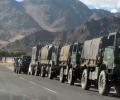
India on Friday said the onus is on China to address the remaining unresolved issues relating to the eastern Ladakh row and that peace and tranquillity along the frontier were key for the restoration of normal relations between the two sides.

At this year's TIME ball in New York City on Thursday, April 25, you would have run into a Coimbatore-born American scientist, looking lovely in Sabyasachi Mukherjee designer finery, who would most likely have been hanging out with Dua Lipa.
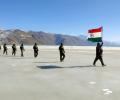
India has told China not to "shift goalposts" and "confuse" managing the border affairs and restoring peace at the frontiers with the larger issue of the resolution of the boundary question, which is dealt with by different designated mechanisms.

India-China relations have always attracted Parliament's attention and there have always been useful and productive and constructive discussions how to engage with China, notes Rup Narayan Das.
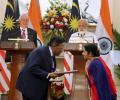
Considering the common linkages, high-level trust, complementarities, and convergent interests between the two nations, Malaysia has the potential to become India's key partner in Southeast Asia, says Dr Rahul Mishra.
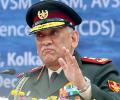
The tearing hurry to form theatre commands has to be replaced by a balanced and deliberate approach. We need to accept that this process will take time if executed correctly and in the best interests of the Indian armed forces, argues Commodore Venugopal Menon (retd).
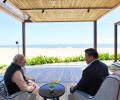
'India's relationship with China has been and will continue to be complex, delicate and sensitive,' says Rup Narayan Das.
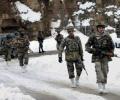
'The Indian Army's surveillance had noticed the Chinese movements.' 'There was no intelligence failure.'

The US said that it supports dialogue between India and Pakistan over Kashmir.
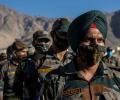
In a strong response to China's objection to development of infrastructure on the Indian side of the LAC, New Delhi also asserted that Beijing has no locus standi to comment on India's internal matters.
Wang Junzheng, Tibet's new Communist party boss, is on a number of sanctions lists by the US, Britain, the EU and Canada, for his tough role in Xinjiang, aimed at China's Uyghur ethnic minority, observes Jayadeva Ranade, the retired senior RA&W officer and distinguished China expert.

President Kovind, who arrived in Dhaka earlier in the day on his maiden State visit at the invitation of his counterpart M Abdul Hamid to attend the golden jubilee celebrations of Bangladesh's independence from Pakistan in 1971, held delegation-level talks with him which was followed by a banquet.

The India-Japan joint naval exercises are a strategic signal for China, observes Dr Rajaram Panda.

Modi will have a number of high-profile multilateral and bilateral meetings with global leaders including United States Vice President Mike Pence and Singapore premier Lee Hsein Loong.

India will look to play a key role in the APEC, EU and Africa regions to increase its competitiveness.

India provides an intrinsic and important link between the developing and the developed world, and maintains a distinct relationship with the United States and China on individual basis, says External Affairs Minister Salman Khurshid.

By jettisoning the vision of multilateral world in favour of a Han Empire, China has posed a major long term challenge to India. India must stand firm against Chinese expansionism but also keep a door open for future detente by making a clear distinction between Chinese people and the current Chinese leadership, observe Lieutenant General Ashok Joshi (Retd) and Colonel Anil Athale (Retd).

The recent breach of ceasefire by Pakistan was aimed at infiltrating Lashkar-e-Tayiba cadres into Jammu and Kashmir ahead of the polls and to bring Kashmir issue back into limelight, as the neighbouring country was feeling isolated with the growing clout of India in the international forum, according to security experts.
